Trending

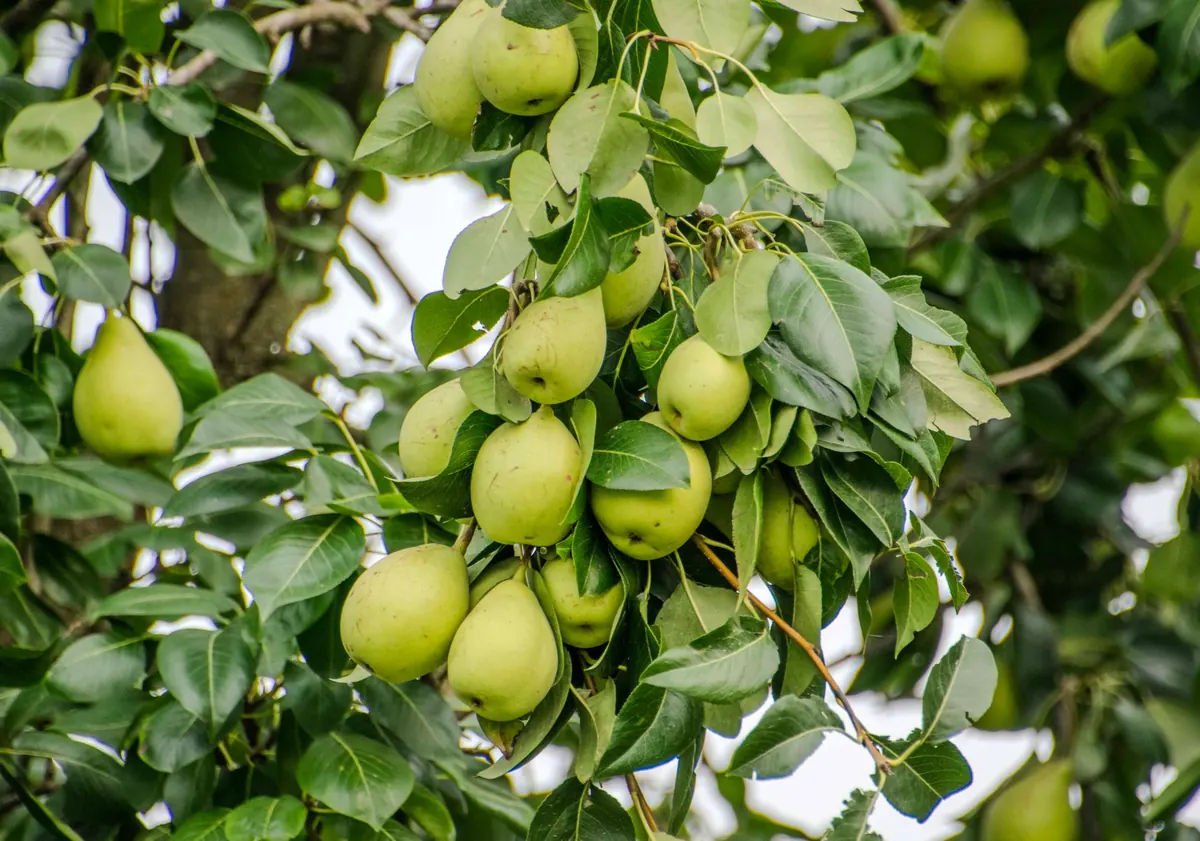
A pear tree is a long-term decision. Get it right and you will still be picking fruit from the same trunk in thirty years; get it wrong and you will spend a decade apologising for a tree that flowers beautifully every spring and crops nothing. Three things decide the outcome: where it stands, what it stands in, and how far it stands from its nearest neighbour. None of them is complicated, but all of them are far easier to sort out before the spade goes in.
Pears flower early — often a week or two ahead of apples in the same garden — so blossom sits in the firing line of late frost. The safest site is one that warms slowly in spring, not a hollow at the bottom of a slope where cold air pools on still nights. A south- or west-facing wall is the classic spot for dessert pears: the masonry holds warmth, ripens the fruit properly and shelters the blossom from wind.
Wind matters more than most people expect. Pear wood is brittle and the crop is heavy, so an exposed tree loses branches long before it loses its reputation. Give it a hedge, a fence or the lee of a building as a windbreak, but not so close that the roots compete for water. Aim for at least six hours of direct sun in summer. Deep shade produces pale, unripened wood, and unripened wood carries few fruit buds — the first step towards a barren tree.
If your site is frosty and slow to warm, choose a later-flowering cultivar rather than fighting the weather with fleece every April.
Pears cope with heavier clay than apples, provided the drainage is there. What they will not tolerate is standing water in winter; roots sitting in a soggy pocket for weeks will sulk for years. Aim for a slightly acid to neutral soil, around pH 6 to 7, with a decent depth of topsoil over broken subsoil.
On heavy ground, plant on a low mound — soil mixed with well-rotted garden compost, firmed into a gentle dome roughly 15 cm high and a metre across. The roots then sit above the water table rather than in it. Don't dig a deep pit and fill it with rich material: roots stay in the comfortable pit instead of reaching out, and the tree grows slowly and anchors badly. Break up the base of the hole with a fork, use the soil you took out, and add a modest amount of organic matter to the backfill.
If you can, avoid planting where an apple or pear has grown before. Old fruit ground carries soil-borne problems that young trees struggle with. Where there is no alternative, plant well away from the old station or replace the soil in a generous planting area.
Rootstock is the single biggest influence on how big your tree becomes and how soon it crops. Ask what you are buying before you fall for the label on the pot.
A few cultivars graft poorly onto quince and are sold either on a pear rootstock or with an interstem to bridge the join. Your supplier will know; it is worth asking the question directly.
Most pears are self-incompatible, which means a lone tree will flower, set nothing, and drop the lot. A handful of cultivars — Conference and Concorde among them — will set a light crop on their own, but even those crop better with a partner nearby.
Two rules govern the pairing. First, the two trees must flower at the same time; a very early cultivar and a very late one will never overlap. Flowering groups are usually listed as early, mid or late season, and two mid-season cultivars are the safest bet if you are unsure. Second, avoid pairing a cultivar that cannot pollinate others. A small number of pears are triploid: they still need a partner themselves, but their pollen is useless to the tree next door.
Bees do the work, so keep the partnership close — ideally within 20 m — and avoid spraying anything insecticidal while blossom is open. If you truly have room for one tree only, pick a partially self-fertile cultivar, or ask a neighbour whether they grow a pear in the same flowering group.
The most common mistake with any fruit tree is burying the graft union — the knuckle where the cultivar joins the rootstock. Plant too deep and the scion roots, the tree grows weakly, and the rootstock's size control is lost.
Bare-root trees go in between November and March while dormant. Container-grown trees can be planted at almost any time if they are watered diligently, though autumn and early spring give the best start. Prune at planting: shorten the leader of a maiden whip to encourage branching, and on a feathered tree keep the well-placed branches and cut back to an outward-facing bud.
As a rough guide for garden planting:
Leave at least a metre between the trunk and a fence, hedge or wall, and more if the hedge is a hungry one. You need to walk round the tree to prune, thin and pick, and a mature pear will cast shade well to the north. Crowding trees is false economy: they compete for water and light, and the fruit suffers first.
Mulch with well-rotted compost or bark, 5–8 cm deep, keeping it clear of the trunk. Water during dry spells for the first two summers — that is when the roots are establishing. Keep a clear circle of 60–90 cm free of grass and weeds, because young pear roots dislike competition.
In the first year, remove the blossom so the tree puts its energy into roots rather than fruit; in the second, leave a few and take the rest off. From the third year, thin the clusters in June to one or two fruitlets every 10–15 cm — a heavy set left unthinned gives you a crop of small, hard pears and a tired tree. Check the stake and tie each spring, and be prepared to leave a dwarfing tree staked for life.
Do that and the tree will do the rest. Set a pear in the right place, at the right depth, with a partner within reach, and you have a plant that will outlast most of what else grows in the garden.
Photo: Rajesh S Balouria / Pexels